
Ladies That Build Bridges


“Translation has played an extremely important role in Japan from the early modern period to the present day. In a sense, translation represents the border at which different cultures meet, given that translation is the place where an idea present in one culture makes its way into another culture at the semantic level.” - The Cultural History of Translation in Japan
I want to celebrate the unsung heroes of Japan, who have been connecting the world with Japan for decades, at least, if I am not wrong. These are the translators, I call them, the humane bridge.
The “humane bridge” provided by these translators is a metaphor for the soft power Japan wields. While the men in suits often dominate the microphones and the boardrooms, it is the women—navigating the nuances of language and etiquette—who ensure that no meaning is lost in the gaps between cultures. They do not just translate words; they translate intent, emotion, and hospitality. This emotional intelligence is a leadership asset that remains largely undervalued in traditional corporate metrics, yet it is exactly what the global economy needs to foster genuine international cooperation.
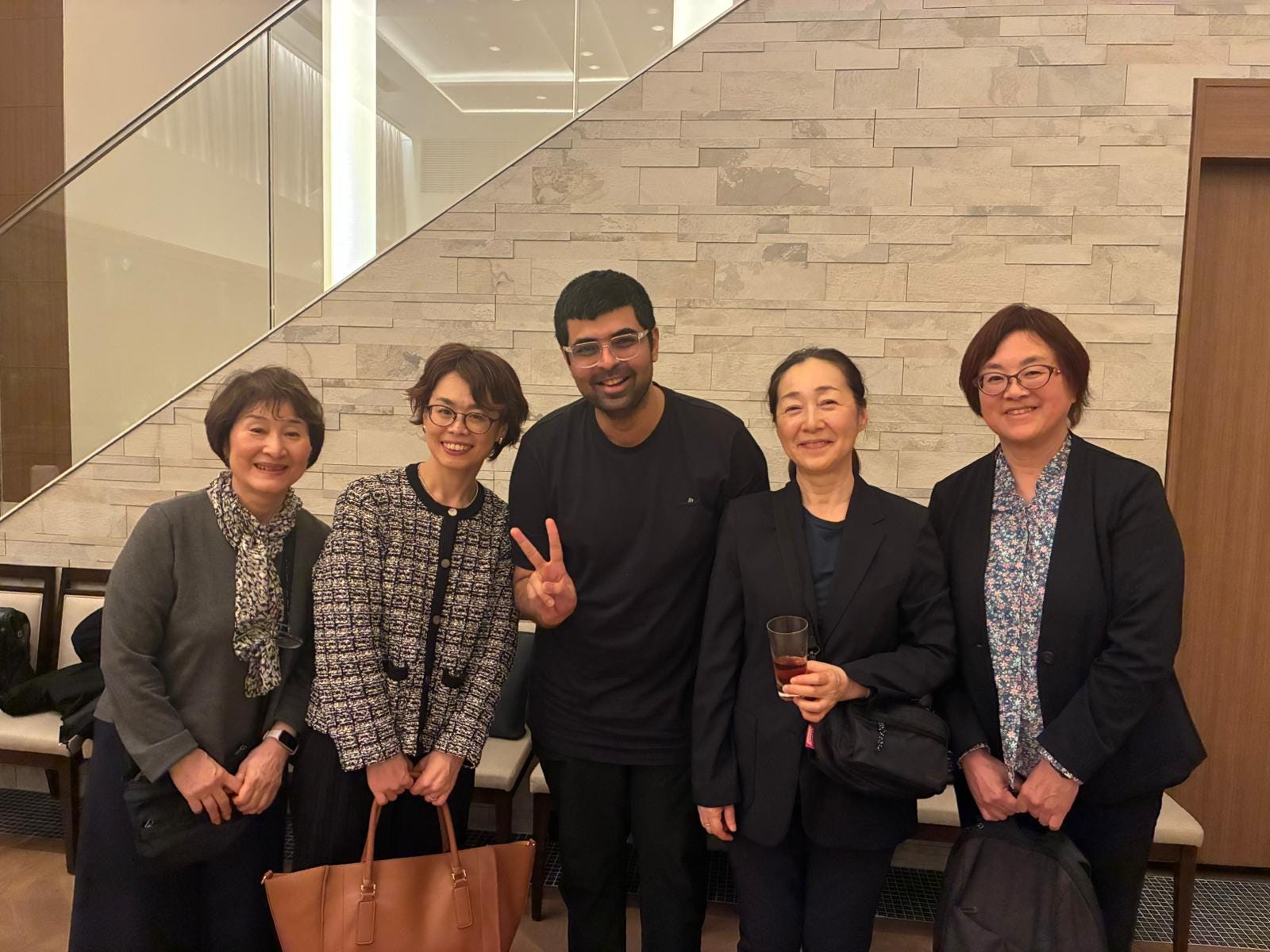
This was my first time attending these meetings, speaking on stage alongside an interpreter. I am well aware of my thick Indian accent; I speak English rapidly and, admittedly, I often “eat” my words. I felt a profound sense of empathy for the translators who accompanied me during this trip—a journey beautifully designed and executed by Yuya-san and Marika-san from JETRO Hiroshima. They put their hearts and souls into the logistics, sometimes running like “headless chickens” to ensure every detail was perfect. The culture of treating others with kindness is deeply rooted in this land. I celebrate both of them, and especially Marika-san.
In a space where almost every invited fund manager and founder we met was male, it was these women, coming from diverse backgrounds, who acted as the true architects of connection. I owe a special apology to Etsuko-san—I nearly gave her a heart attack several times by skipping sentences, changing my phrasing mid-thought, or getting too excited on stage and speaking at a breakneck pace. I want her and all the translators to know that I saw them as the backbone, the glue, and the bridge connecting us to government officials and the local community.
During my time in prefectures such as Hiroshima (including Kure) and Ehime, I realized that the Western narrative about the state of women in Japan isn’t entirely accurate. I observed that women are, in fact, the backbone of this nation.
Fact: Women’s labor force participation in Japan has risen sharply to roughly 78% for ages 15–64 (as of June 2025), driven by policy changes (”Womenomics”), increased childcare capacity, and labor shortages.
The issue is that they are not in the front seat; they are not the decision makers.
Fact: Women are underrepresented in leadership, with only 13% of management roles held by women in the private sector, well below the OECD average of 34%, reports the IMF eLibrary.
Fact: Despite high participation, about 54% of employed women work in non-regular positions (part-time, contract, or temporary), which often feature lower wages, fewer benefits, and less job security, according to the IMF eLibrary.
To move from the “backbone” to the “front seat,” Japan’s structural evolution must match its cultural spirit. The transition from 78% participation to meaningful leadership requires more than just filling quotas; it requires a reimagining of the “salaryman” culture that has long dictated the rhythm of Japanese life.
I firmly believe Japan has the right fundamentals to not only cultivate the next generation of female leaders but to lead the world in a compassionate, human-centric way. The girls, women, and mothers of Japan are already leaders, translators, builders, and entrepreneurs. Most importantly, they are the “glue” that can harmonize genders and bridge different races and ethnicities. We must afford more respect to our mothers and sisters, for without them, our existence would not be possible.
Japan has much to teach the world about resilience, but it also has much to learn about creating a society where women do not feel trapped by marriage, can fully unleash their potential, and have clear career pathways. If I had a daughter today, I would tell her: “Go fly, ‘chan,’ go fly!”
Ultimately, celebrating these women is not just about acknowledging their hard work; it is about recognizing that they are the pioneers of a new Japan. They are proving that you can be efficient without losing your heart, and professional without losing your kindness. As Japan continues to open its doors to the world, it is these “bridge-builders” who will define the nation’s future. To the women I met: your work is seen, your patience is appreciated, and your contribution is the very foundation upon which a more inclusive Japan is being built.
I hope this message reaches Taikaichi-san as a gift to her and to the daughters, mothers, fathers, and sons of this land.
Arigato Gozaimasu, Marika-san and Yuya-san for inviting me over to Hiroshima and Ehime, and thank you to “Ladies That Build Bridges.” I hope I can create net value for you all, for the land, and for the planet.
—
If you are building something in the Nordics, Singapore, or Japan, I’d love to learn more from you. Please reach out to me at nobody@firstfollowers.co.
Peace out!
—
Who am I?
Nobody.
And that is everything.
—
My life purpose is to fight the way people say capitalism and to build a system people see as a system of hope, not extraction and abuse. Where gender, race, ethnicity, and identity don’t matter - where the compassion and empathy circle is extended to nature, to sentient beings, and non-sentient things - finance that is rooted in kindness. I don’t want to approach finance from fear to lose or be rich, but see it as a tool to allocate resources - I don’t know if I will fail or be successful, but I am content, and I always come back to the fundamentals - to the values and to the morality questions.
—
You might also enjoy reading the following pieces:
The Art of Stillness

I am sitting in a space in Helsinki, listening to the birds chirping, and my mind feels zoned out, relaxed, and calm. I just finished reading the short book by Pico Iyer, The Art of Stillness, and yes, shamelessly, I used it as the title of my essay. The book is based on his famous TED talk, “
The Sacred Art of Silence

In these past few years, I have been given a gift—one that most fear, few understand, and even fewer embrace. It is the gift of silence—not the hollow silence of loneliness, but the rich, resonant silence of solitude—a silence that does not empty but
Scale?

I hear this word a lot, whether I talk to a cutthroat capitalist, a climate activist, or a philanthropist. In the name of impact & urgency, we strive to scale at any cost to create a lasting impact. I fear it sounds similar in the name of becoming a billionaire quickly; we want to scale a business at any cost. I fear “scale”; to me, scaling up at any cost is like a virus, and we know viruses are not beneficial and could wipe out humanity. I worry that we in mainstream culture are obsessed with scale, but we forget that in the name of scale, products lose their soul, create centralized hierarchical workplaces, toxic work cultures, and pressure. It’s less of a proven scientific law and more of a critical observation supported by evidence from economics, sociology, and business studies.
 | A guest post by
|